Shine your light on me
Shine your light on me
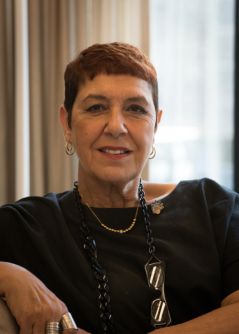
N’arweet Dr Carolyn Briggs AM
Boon Wurrung
Interviewed by Monique Grbec
August 2020
Two minutes’ walk from the concrete streets, towers and apartment blocks of St Kilda Junction in Melbourne, the veneer of colonial civilisation is stripped back. Here on Boon Wurrung Country, where there was once a wetland as diverse as Kakadu, Yaluk-ut Weelam Elder Aunty Carolyn Briggs oversees a small patch of regenerated land. A place for reflection and rejuvenation, the land is alive with bird song, grasses, bushes, and trees. Water catchments and paths bend like ancient rivers to reveal stories from the Yaluk-ut Weelam Clan (People of the River), a civilisation united with the land through initiation, education, feasting, medicine and ngargee (song, dance and ceremony).
An Elder celebrated in the 2005 Victorian Honour Roll of Women, and as the 2011 NAIDOC National Female Elder of the year, Aunty Carolyn is passionate about regenerating all aspects of the Boon Wurrung culture, empowering our people, and ensuring the young ones learn the knowledge and skills to not just survive in this world but to thrive. An elected member of the First Peoples’ Assembly of Victoria, Aunty is at the forefront of this country’s Treaty negotiations.
We stroll past a replica shell midden inlaid with chunks of water-worn green and blue glass, a sign of early traders sharing seafood feasts by the fire. With Eastern Kulin Country under COVID-19 stage four travel restrictions, there are no travellers visiting this usually bustling area; today, there are just a few locals wearing facemasks. “We will never be the same,” Aunty says about a post COVID-19 world. “It’s a good thing… time for a colonial structure reformation… time to consume less.”
Having recently completed a doctoral degree researching how Elders can assist urban Aboriginal youth to understand culture, Aunty is now working from her Boon Wurrung Foundation office where she writes children’s books, researches, and uses Zoom to give training and Blackfella support to young ones living in urban and rural areas. “People are angry and frustrated… disempowered by perpetual grief.” For youth living in areas without easy access to urban amenities, such as education and health services, the coaxing clarity of Aunty’s conviction and aspirations offers guidance to help them articulate areas of their life where they are struggling.
On a journey to pay respect to the oldest ngargee tree at Euro Yuroke on Boon Wurrung Country, the brilliance of hundreds of bright yellow pompoms light up the shadow made by the canopy of tall trees. A young blackwood wattle beckons us to stop; each burst of sunshine blossom is an Elder past. With the 20 metre tall ngargee tree towering in the background, this is a place to feel empowered. Here, the privilege of standing with Elders past and the electrifying Aunty Carolyn as an Elder present, marks a light bulb moment of lore.
Aunty, a health-focused foodie and former restaurateur championing the role of Indigenous cuisine, glows when talking about the regenerated habitat surrounding us. For the Boon Wurrung, every part of the black wattle has a function as food, medicine, cleaner, binder, or shelter. In this month of August when the black wattle blooms, we know the roots are edible. As well as food, the roots make a home for truffles, bind erosionprone soil, and produce bacteria that can fix atmospheric nitrogen. The cracks and crevices in the bark are home to insects, vertebrates, fungi, bacteria for use as an antiseptic, and tannin for ochre, glue, and healing. The bark can be split into lengths of string to make baskets and bind flint heads to spear shafts. The limbs can be flexed into lean-tos and frames for mud-wall huts. The wood is used for boomerangs, spear throwers, spears, digging sticks, shields and clubs. The kino (gum/sap) forms balls to suck and chew, and the nectar is used for drinking, and as a medicine for coughs, cuts and abrasions. The seeds are edible and grinded into flour, and the smoke from its burning is used as a treatment for diarrhea.
As we reach the ngargee tree – the ancient red gum eucalyptus that stands on the edge of the Queens Way on-ramp – we see that even during COVID19 stage 4 travel restrictions there is a steady stream of traffic. When the road was built it was diverted around the ngargee tree. Aunty Carolyn, like the magnificent ngargee tree, has the strength, power and persistence to bend the will of bureaucrats. With culture that has survived colonisation and the various stages of development that led to the gentrification of this Boon Wurrung Country, it is time for the old world to heal the new.
Aunty Carolyn is a respected Boon Wurrung senior Elder and descendant of the First Peoples of Melbourne, the Yaluk-ut Weelam clan of the Boon Wurrung. She has promoted Boon Wurrung culture, and supported opportunities for Indigenous youth for over 40 years. In 2005, Aunty Carolyn established the Boon Wurrung Foundation, which undertakes significant work in cultural research, including restoration of the Boon Wurrung language. The Foundation also helps connect Aboriginal youth to their heritage. Aunty Carolyn completed a Doctorate of Philosophy for which she researched the ways knowledge of Elders can assist urban Aboriginal youth to understand their culture. Her cultural knowledge and experience is recognised by communities throughout Australia. She is the recipient of many awards including the 2011 NAIDOC Female Elder of the Year. In 2017, she was inducted into the Victorian Aboriginal Honour Roll