Interview with
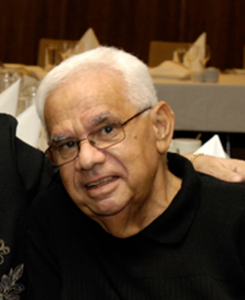
Uncle Kevin Coombs
Wotjobaluk
Words by Steve Dow
June 2020
Wotjobaluk Elder, Uncle Kevin Coombs, says he’s had a “shocking” few months, largely confined to the two-bedroom unit he shares with his wife, Linda, in Pascoe Vale, a suburb north of Melbourne.
Life during the COVID-19 era of social isolation means he has rarely ventured outside.
“I’m going from the lounge room to the kitchen to the bedroom,” laughs the 79-year-old, maintaining his humour about his drastically foreshortened travel itinerary.
“It’s a bit claustrophobic only doing that for so long.”
In his younger days, Uncle Kevin travelled the world, competing in the first Paralympic Games in Rome in 1960 and captaining and coaching wheelchair basketball into the late 1990s.
At age 12, he was left with paraplegia after being accidentally shot in the back, and was later introduced to basketball as part of an Austin Hospital rehabilitation program.
To speak to Koorie Heritage Trust Voices three months into the coronavirus restrictions in Australia, Uncle Kevin has postponed a rare treat: a visit to the barber’s for a haircut.
Other permissible trips have included a check-up with his Fitzroy-based doctor, who confirms Uncle Kevin is in good health with robust immunity because he’s been eating well and avoiding alcohol.
He is missing shopping trips with Linda, however, who now ventures out alone to get their groceries.
“I’ve got a very good wife and she’s the key to my health nowadays,” he says. “Well, has been all along.”
He knows one other Aboriginal man who tested positive to the virus. “It’s very dangerous as you get older to pick up any type of illness,” he says.
Uncle Kevin longs to again attend committee meetings for the Melbourne Poche Centre for Indigenous Health, and for Murrup Barak, the Melbourne Institute for Indigenous Development.
His decades of experience with young Koorie people have enriched the missions of these two Melbourne University organisations.
For 13 years, he was an Elder with the Koori Courts. He also helped establish and manage Victoria’s Koori Health Unit, and was an ambassador for the National Indigenous Strategy for Literacy and Numeracy.
As a young man, Uncle Kevin knew of four Indigenous people who “got killed in jail”. While personally attending the recent Black Lives Matter rally in Melbourne was out of the question, Uncle Kevin says his two children, eldest daughter Janine Coombs, a native title and Treaty campaigner, and younger daughter Rose Falla, a magistrate, participated along with a granddaughter.
“But I don’t get involved with stuff like that,” he adds. “I think it all comes back to I’m more interested in getting people educated.”
Born in Swan Hill in 1941, Uncle Kevin lost his mother, Rosie, at the age of five, after which he lived alongside his four siblings with relatives in Balranald, in the New South Wales Riverina district, where he attended primary school, helping out in his uncle’s timber yard.
What advice would he give to himself as a young boy happiest playing out bush?
“I suppose it comes back to education. If you’ve got a good education, I tell a lot of kids here in Melbourne because I worked in the Koori Courts, I’d always say to the young blokes, while you’re in gaol or in the centre for youth, maybe you can study up and see if you can get a bit of education behind you.
“One of the big judges down here, he had a saying: If you open a school, you close a gaol. He’s pretty right there.”
Uncle Kevin feels a glow when recollecting his sporting career. “Oh mate it was fantastic to be involved,” he says. “I’ve still got a lot of friends in the para movement here in Australia and a few in America because I travelled a bit. I made a lot of friends. Played against the best and it was just a great career, mate.
“It helped me when I retired. Because I was pretty well known, it opened up a lot of doors for me in employment.”
What needs to change for reconciliation to be achieved? “Respecting each other as people,” he says.
Uncle Kevin is optimistic that Indigenous literacy and numeracy levels can be raised. He looks on with pride as the Poche Centre for Indigenous Health continues to “bring the next leadership of Indigenous people in Australia forward”, while Murrup Barak offers a place where Aboriginal students can “come and be themselves”, he says.
“We encourage them to study and get through. One of my granddaughters went through there and she got a degree. She’s earning big money now. It was about three years ago. She’s done very well.”
Whenever a young Indigenous person is facing self-doubt, Coombs is fond of quoting Marcia Langton, the Foundation Chair in Australian Indigenous Studies at Melbourne University.
“Marcia said, don’t ever feel guilty about getting an education because you bloody deserve it.”
Nor will Uncle Kevin be holding himself back much longer. “In the next couple of days I’ll be getting myself out of this unit and having a look around,” he laughs, “and getting my hair cut.”
Uncle Kevin Coombs is a Wotjobaluk Elder. He has received the Medal of the Order of Australia, an Australian Sports Medal, induction to the Basketball Australia Hall of Fame, a Deadly lifetime achievement award and a NAIDOC award.
At 12 years of age, he was left with paraplegia and introduced to basketball as part of the Austin Hospital’s rehabilitation program. He captained the Australian basketball team at the 1972 Paralympics, the 1974 Commonwealth Games, the 1977 Silver Jubilee Games and the 1980 Paralympics. Uncle Kevin also became an advocate for disabled sport through Wheelchair Sports Victoria (now Disability Sport and Recreation).
Uncle Kevin was the Aboriginal representative on the National Committee for the International Year of Disabled Persons (IYDP) and helped establish and manage Victoria’s Koori Health Unit. He also served on the board of Aboriginal Hostels Ltd for 19 years.
Uncle Kevin addressed a special sitting of the Victorian Parliament in 2000 and is an ambassador for the National Indigenous Strategy for Literacy and
Numeracy. He is patron of the Onemda Koori Health Unit at Melbourne University and sits as an Elder on the Broadmeadows Koori Court and Children’s Koori Court.